

 Pristupačnost
Third- and fourth-year students of Demography and Croatian Emigration Studies, accompanied by lecturers Monika Komušanac and Tamara Bodor, spent time in the city of Pécs—a cultural hub for Croats in Hungary—from May 8th to 11th as part of their "Fieldwork I" and "Fieldwork II" courses.
Visit to the Consulate General of the Republic of Croatia and the Croatian Theatre in Pécs
On the first day, the students had the opportunity to visit the Consulate General of the Republic of Croatia in Pécs. They were warmly welcomed by Consul General Drago Horvat and Consul Advisor Miona Ševčik, who outlined the scope of their work and their cooperation with the Croatian community—a significant minority in the city of Pécs. Following the introductory remarks, the students were able to ask questions regarding the practical operations of the Consulate and the status of Croats in Hungary. The representatives answered all questions willingly and patiently, fostering an open dialogue and exchange of ideas, which added significant value to the meeting.
In the evening, the program continued with a visit to the Croatian Theatre in Pécs—the only professional Croatian-language theatre institution outside the Republic of Croatia (alongside the one in Mostar). The students attended the premiere of the play "Tóték" by István Örkény, performed in Croatian. The production impressed the audience with its powerful performance, atmosphere, and underlying message, earning the cast a long, sustained round of applause. Miroslav Krleža Educational Center
On the second day of their field trip, the students had the opportunity to visit the Miroslav Krleža Educational Center and the Faculty of Humanities at the University of Pécs. They attended a lecture on Croats in Hungary delivered by Professor Stjepan Blažetin, who later accompanied the students on a tour of the city center and introduced them to the Deputy Mayor of Pécs, Gábor Zag.
Janja Živković Mandić, the principal of the Miroslav Krleža Educational Center—who is a teacher of Croatian language and literature and a former student of the school—gave a presentation on the school’s operations. The deputy principal, Rita Magyar—a teacher of German, Croatian, and ethics—then led the students on a tour of the Center, which comprises a kindergarten, an elementary school, a *gymnasium* (secondary school), and a student dormitory. The elementary school has been in operation since 1952, the kindergarten since 1976, and the *gymnasium* since 1983. Instruction is provided in both Croatian and Hungarian. A key subject is "Croatian Studies" (*hrvatski narodopis*), which encompasses literature, language, history, ethnography, geography, music, architecture, and minority policy. The students come from diverse backgrounds—often from families where Croatian is not spoken—yet the school succeeds in integrating these children and developing their language proficiency, reaching levels as high as C1. The Center collaborates with ten partner institutions, including elementary schools, student dormitories, and faculties in Croatia, one of which is the Faculty of Croatian Studies. Department of Croatian Language and Literature, Faculty of Humanities, University of Pécs
The University of Pécs, which dates back to 1367, houses an Institute of Slavic Studies that includes a Department of Croatian Language and Literature. Although the department has existed since 1949, it currently consists of only five faculty members. Students arrive with varying levels of prior knowledge of the Croatian language; enrollment is limited by the requirement that students possess a sufficient command of the language to follow the coursework. Professor Stjepan Blažetin delivered a lecture titled "Croatian Traces in Pécs," which covered the migration routes of Croats into Hungary between the 16th and 18th centuries, as well as the current situation of the Croatian community in Hungary. According to estimates by the Hungarian Central Statistical Office, there are currently about 35,000 Croats in Hungary. As for Pécs, it is estimated that between three and four thousand Croats live in the city today. A challenge for the better organization of Croats in Hungary is their high degree of geographical dispersion; some reside near the Austrian border, others live around the capital, Budapest, or near the border with Slovakia. This issue is further exacerbated by poor connectivity (motorways in Hungary are of modest quality).
Tour of the City Center and Meeting with the Deputy Mayor of Pécs
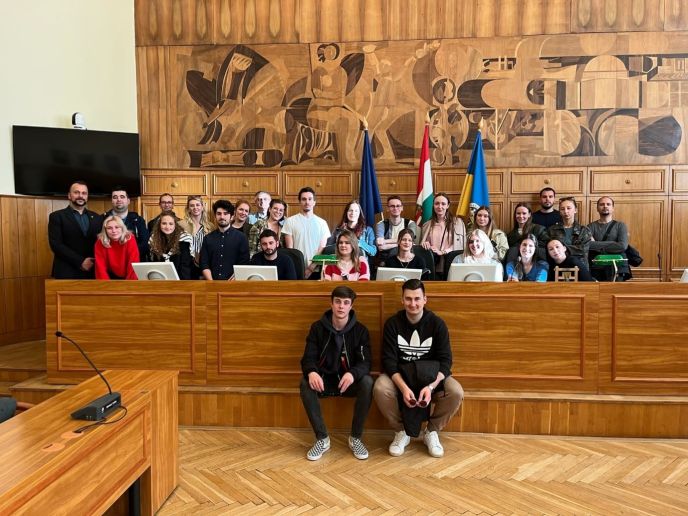
During their tour of Pécs, the students visited the Cathedral of Saints Peter and Paul—a landmark structure and the city's spiritual center. Mr. Stjepan Blažetin facilitated access to the Gymnasium building where the prominent Croatian writer August Šenoa—after whom the Croatian Academic Club in Pécs is named today—was educated between 1849 and 1851. The tour concluded with a visit to the City Hall, where the students were welcomed by Deputy Mayor Gábor Zag. In his address, he discussed the political system, the functioning of local government, and the status of Croats in Pécs. The talk was followed by a tour of the City Hall building, which ended with a visit to the top of the tower, offering a panoramic view of the entire city of Pécs.
Ethnographic Museum of Croats in Mohács
On the third day of their field trip in Hungary, students of demography and the Croatian diaspora visited the Dorottya Kanizsai Museum, located in the center of Mohács. The museum was founded in 1923 and is the only museum institution in the town of Mohács. The primary objective of the museum is to showcase historical and ethnographic research concerning Mohács, as well as to collect, preserve, and document the material and intangible heritage of Croats, Serbs, and Slovenes in Hungary. The students had the opportunity to view various folk costumes, musical instruments, and the attire of the *busó*—which consists of a sheepskin coat and linen trousers stuffed with straw, worn with colorful knitted wool socks and either boots or *opanci* (traditional leather footwear). Also on display were household utensils and other items used by South Slavs in Hungary.
Turkish-Hungarian Friendship Park in Szigetvár
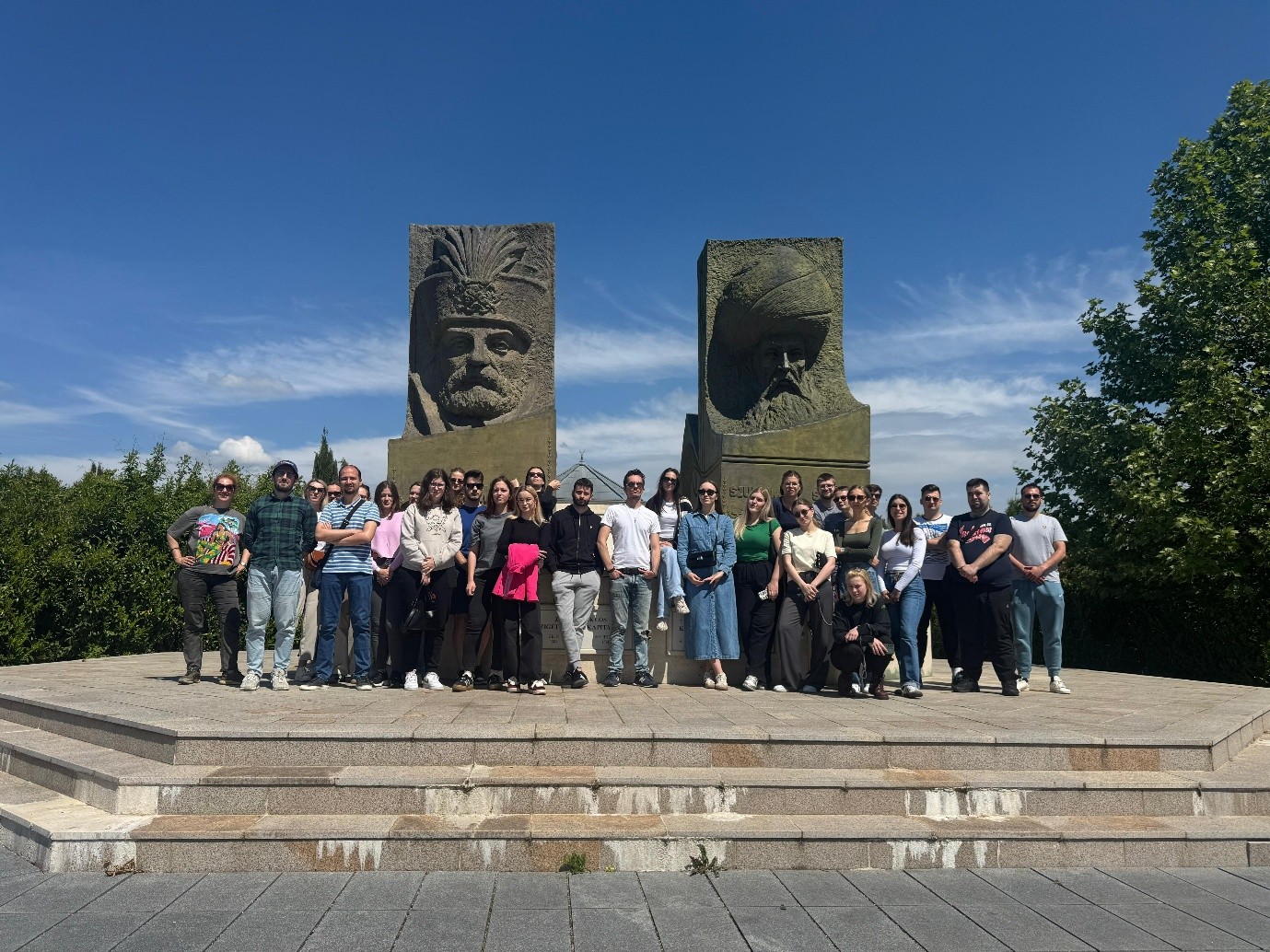
On Sunday, while returning to Zagreb, the students visited the Turkish-Hungarian Friendship Park near the Hungarian town of Szigetvár. There, in commemoration of the famous battle of 1566, bronze busts of Nikola Šubić Zrinski and Suleiman the Magnificent have been erected.