


 Pristupačnost
The Department of Sociology was established in 1992 and is one of the core disciplines of the Faculty of Croatian Studies. The concept of sociology studies focuses on the application of sociological theories and social science methodology for understanding social processes and phenomena in the specific context of Croatian society and comparatively in a European and global perspective. The study of sociology aims to train highly qualified sociological research personnel with professional research and analytical skills necessary for productive work in the public and private sectors. The sociology program at the bachelor's and master's levels is organized according to current international scientific standards.
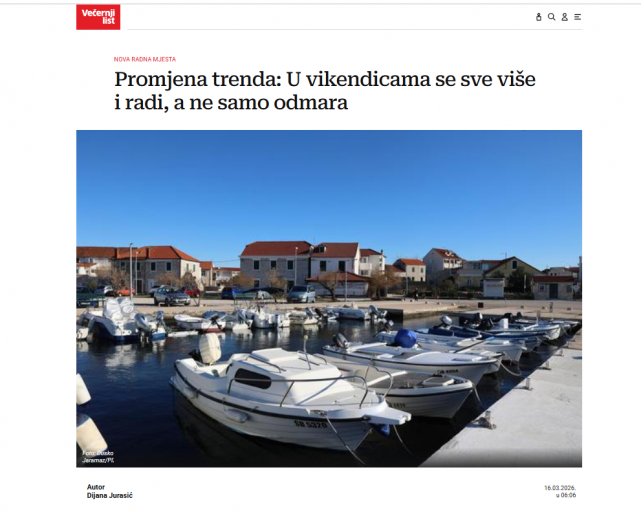
On Monday, 16 March, Večernji list published an article presenting the findings of the above-mentioned scientific study on remote work from second homes. The article is based on the research published in the paper “From leisure retreat to working heaven: factors influencing remote work from second homes”, released in late 2025 in the journal Fennia.
 The paper is authored by senior researchers Geran-Marko Miletić, PhD, and Krešimir Peračković, PhD, from the Ivo Pilar Institute of Social Sciences, and Associate Professor Marica Marinović Golubić, PhD, from the Department of Sociology, Faculty of Croatian Studies, University of Zagreb. The study examines the transformation of second homes—from spaces of leisure to spaces of work.
The findings show that more than half of employed respondents (52%) had experience working remotely from their second homes, while a significant proportion reported doing so occasionally or regularly. Second homes are thus increasingly becoming “second residences” that enable the blending of professional and private activities.
The authors highlight that this form of work is more common among highly educated employees, particularly in sectors such as management, IT, law, and creative industries. Key factors include the availability of digital infrastructure and the flexibility of working conditions.
The study also points to the broader social implications of this phenomenon, including changes in the organization of everyday life, the relationship between work and leisure, and the potential contribution to the development of local communities.
The Večernji list article is available via a subscriber-only link, while the full scientific paper is accessible in open access via the provided link.