

 Pristupačnost
The Department of Sociology was established in 1992 and is one of the core disciplines of the Faculty of Croatian Studies. The concept of sociology studies focuses on the application of sociological theories and social science methodology for understanding social processes and phenomena in the specific context of Croatian society and comparatively in a European and global perspective. The study of sociology aims to train highly qualified sociological research personnel with professional research and analytical skills necessary for productive work in the public and private sectors. The sociology program at the bachelor's and master's levels is organized according to current international scientific standards.
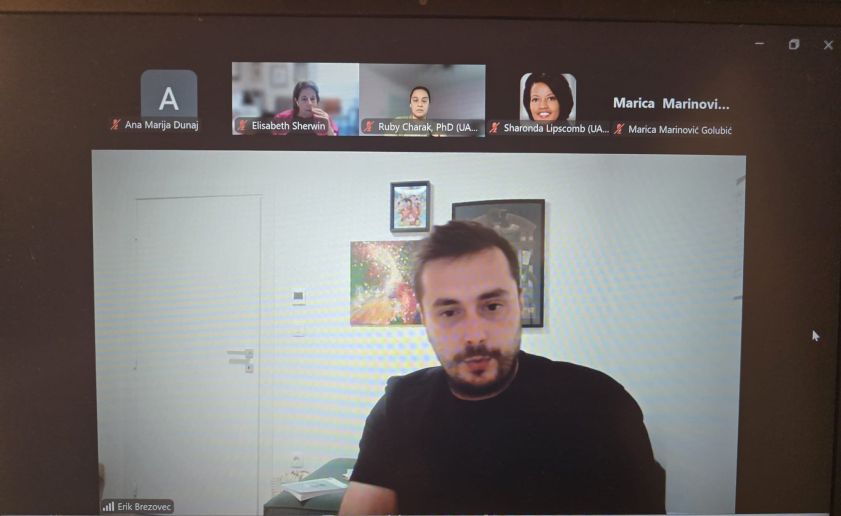
Yesterday in the late afternoon, an online panel discussion titled “Vulnerability: Definition and Measurement” was held, organized as part of the institutional research project DIGI-HR and an international collaboration between the Faculty of Croatian Studies, University of Zagreb, and the University of Arkansas at Little Rock.
On behalf of the partner institution from Arkansas, the opening remarks were delivered by Professor Elisabeth Sherwin, professor and research project leader at the University of Arkansas at Little Rock. In her address, she emphasized the importance of international collaboration in vulnerability research and invited other scholars to actively engage in future discussions and joint projects.
The panel brought together researchers and participants interested in issues of social and digital vulnerability, digital inclusion and exclusion, as well as methodological approaches to their definition and measurement. The central presentation was delivered by the head of the DIGI-HR project, Assistant Professor Erik Brezovec, who introduced contemporary theoretical and empirical approaches to understanding vulnerability.
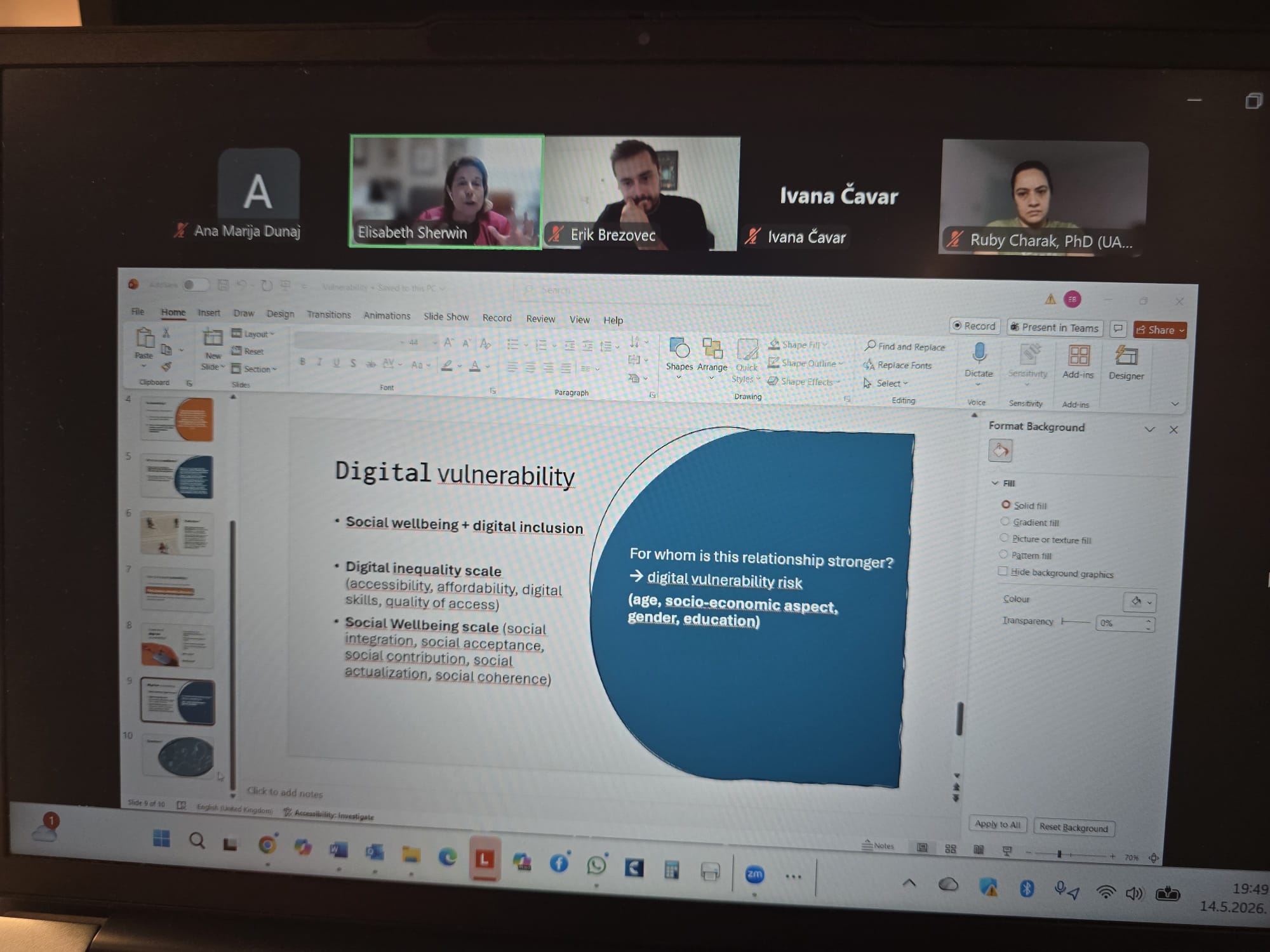 In his presentation, Brezovec further elaborated on the concept of vulnerability in the context of digital inclusion and exclusion, emphasizing that it should not be understood as a fixed characteristic of certain groups, but rather as a relational and measurable phenomenon. As he pointed out, vulnerability arises in situations where individuals or groups have limited opportunities to access, use, or benefit from digitally mediated forms of communication, participation, and everyday functioning.
He also highlighted that vulnerability results from the interaction between risk and response capacity, suggesting it can be understood through the relationship: risk + response = vulnerability. At the same time, it emerges from the broader interplay of structural inequalities, social position, and limited resources that affect individuals’ ability to anticipate, avoid, or recover from adverse circumstances. Such an approach enables empirical research on vulnerability through dimensions such as digital autonomy, dependence on support, and the consequences of digital exclusion for social participation and well-being.
Brezovec also stressed the importance of distinguishing between vulnerability and resilience, noting that individuals or communities may be vulnerable in one aspect while resilient in another.
In the context of digital vulnerability, key factors highlighted included access to digital resources, levels of digital skills, socioeconomic status, and opportunities for social participation. It was emphasized that digital inequality is multidimensional, encompassing not only access and affordability but also quality of use and digital competencies.
During the discussion, Associate Professor Marica Marinović Golubić from the Department of Sociology at the Faculty of Croatian Studies also presented an additional international project conducted in collaboration with Michigan State University. The project focuses on foreign workers from Asia in Croatia, examining various aspects of their lives, work, and safety, and highlighting that this group is often exposed to multiple forms of social and digital vulnerability.
The panel discussion sparked a lively and substantive exchange among participants, raising numerous questions related to the operationalization of vulnerability and its applicability across different research contexts.
It was announced that the next panel will be held in June with a broader circle of participants, and an open invitation was extended to other researchers working on social and digital vulnerability to join future discussions and collaborations.