


 Pristupačnost
The Department of Sociology was established in 1992 and is one of the core disciplines of the Faculty of Croatian Studies. The concept of sociology studies focuses on the application of sociological theories and social science methodology for understanding social processes and phenomena in the specific context of Croatian society and comparatively in a European and global perspective. The study of sociology aims to train highly qualified sociological research personnel with professional research and analytical skills necessary for productive work in the public and private sectors. The sociology program at the bachelor's and master's levels is organized according to current international scientific standards.
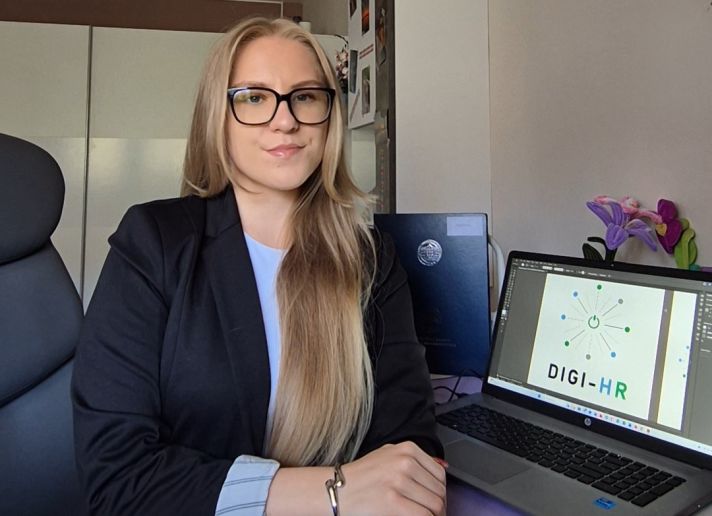
When the DIGI-HR project team began searching for a visual identity that would communicate digital inclusion and exclusion in Croatia, no one expected the solution to come from a second-year graduate sociology student. And yet—on closer reflection—perhaps she was the most suitable person for the task.
Sonja Novak, from the Varaždin area, is not a graphic designer by profession. However, just a few weeks ago she completed a four-month course where she mastered three core design programs. When the project leader, Asst. Prof. Erik Brezovec, and team member Asst. Prof. Ana Marija Dunaj realized that their own attempts at creating a logo were not producing the desired result, Sonja offered her help. And—the logo was created.
The DIGI-HR project—Dimensions of Digital Inclusion and Exclusion in the Republic of Croatia—is an institutional research project of the Faculty of Croatian Studies that examines how and why certain social groups remain on the margins of the digital world. This is not merely a technical issue of internet speed or device availability; it reflects inequalities related to age, education, place of residence, and economic status.
Sonja was already familiar with this topic from within—as a sociology student training for research work. When she sat down at her computer, she did not search for a metaphor online. She found it within the subject itself.
 “At the center of the logo is the on/off symbol. The dashed lines represent weaker connectivity and limited access, while the solid lines indicate stronger integration. I wanted the logo to convey the possibility of change,” explains Sonja Novak, the author of the logo.
The result is a logo in which lines radiate from a central on/off switch—some solid, some dashed—ending in circles in blue, green, black, and gray. It is the visual language of a network, but also of its absence. A line drawn between those who are digitally included and those who are not—precisely what the project explores.
For Sonja, this engagement was not only a design challenge. It was also a personal breakthrough. Creativity, she says, was inherited from her grandmother and mother, but for a long time it remained within what felt “safe.” The turning point was a university assignment—designing the visual identity of an imaginary company—which showed her that the boundary between sociological thinking and visual expression might not be so distant after all.
She enrolled in a course. She navigated the challenges of online classes, exercises in programs she had never used before, and deadlines that accumulated alongside her coursework and seminars. And she arrived at a logo that now stands alongside the name of her faculty’s research project.
“This project represents my first more serious independent step in creative work—the moment when I broke the ice,” says Sonja. She adds that choosing the research track in sociology has further shaped her approach to design:
“Given that I chose a research-oriented path in sociology, I believe that the combination of sociological knowledge and the skills I acquired through graphic design education can contribute to clearer, more accessible, and more precise communication of messages to different audiences.”
Looking ahead, she hopes to continue developing visual solutions that combine a sociological perspective with creative methods, as well as to participate in research projects that connect analytical understanding of society with innovative ways of presenting content. Because sometimes it is precisely this combination that data needs in order to become visible—and understandable.
The official project website is expected to be launched soon, further bringing its goals and results closer.